

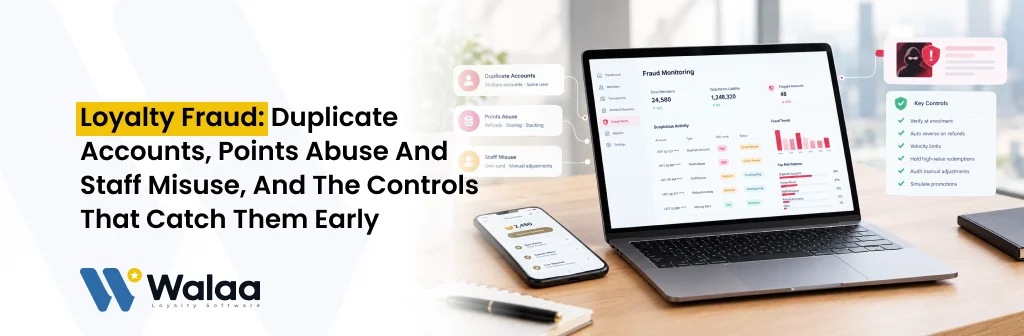
Points are a form of currency, and anything that behaves like currency attracts abuse. Most programmers don't discover fraud through a clever detection system. They discover it when finance notices that liability is growing faster than sales, or when a store manager mentions that one cashier's customers seem unusually generous with their points. The better approach is to understand the common patterns and put inexpensive controls in place before launch, when changing the rules costs nothing.
The three patterns that show up most
Duplicate and fake accounts. One person registering several times to collect sign-up bonuses, or splitting purchases across accounts to game tier thresholds or referral rewards. This is the most common pattern, and it scales easily once someone finds the gap.
Member-side points abuse. Buying and refunding to keep the points, sharing accounts to pool balances, or exploiting a promotion stack nobody modelled. Some of this is deliberate fraud, but a lot of it is ordinary people responding rationally to a rule that was more generous than intended.
Staff-side misuse. Cashiers scanning their own card on customers' transactions, adding points to friends' accounts, or keying in manual adjustments without a reason. This is the one programmers most often underestimate, because the person with access is trusted and the volumes can look like normal activity.
Controls that work
Verify at enrolment. Mobile number verification by one-time code removes a large share of throwaway accounts. Tie one verified identity to one account, and think carefully about what a referral reward requires before it pays out. A completed first purchase is a far stronger trigger than a sign-up.
Reverse points on refunds automatically. If a refund doesn't claw back the points, you've built a points machine. The ledger should handle reversal even when the member has already spent part of the balance, either by creating a negative balance or by holding the remainder against future earnings.
Set velocity limits. Cap how many transactions, earn events or redemptions one account can make in a window. Legitimate members rarely hit these limits, while abusers do. Apply the same logic to a single till or terminal.
Delay and hold high-value redemptions. A short review period on large redemptions, especially from new accounts, gives you a chance to catch a problem before the reward leaves the building.
Audit every manual adjustment. A manual points change should require a reason code and record who made it and when. Report on adjustments by staff member and outlet, and look for outliers. A single cashier whose adjustments are triple the outlet average deserves a conversation.
Model promotions before launch. A surprising amount of "fraud" is really an unintended stack of promotional rules. Simulating a new promotion against historical baskets catches this before members do.
Keep false positives low
A control that blocks genuine members does more damage than the fraud it prevents. Flag for review rather than auto-block wherever you can, and make it easy for a real member to resolve a hold. The goal is to raise the cost of abuse, not to treat every member as a suspect.
Make it part of governance
Fraud controls work best when someone owns them. Assign a named person in finance or operations to review exception reports monthly, agree thresholds with the business, and revisit them when a promotion changes the economics. A control nobody reads is no control at all.
Why choose Walaa
Walaa's points ledger is auditable down to the transaction, with automatic reversals on refunds, velocity rules, role-based permissions and a full audit trail on every manual adjustment. Suspicious patterns surface in reporting, so finance finds them in days rather than at year-end, and the rules engine's simulation catches promotion stacking before it goes live.
Walaa is a custom loyalty platform built with the controls and audit trail that keep points liability honest.