

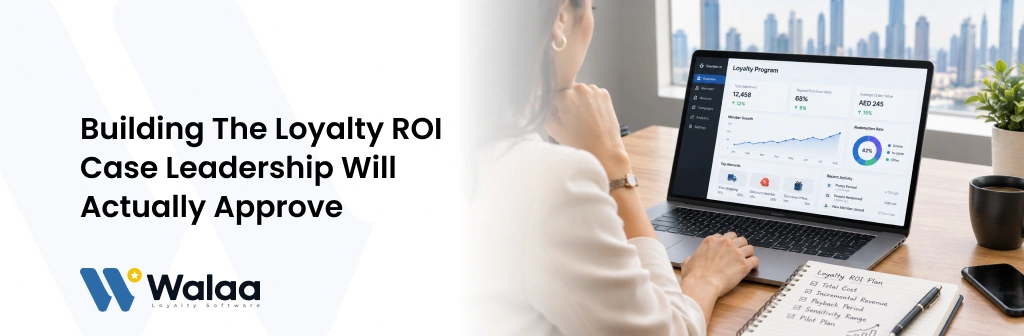
Every loyalty programme pitch eventually reaches the same slide: a projected lift in repeat purchase rate, a nice round percentage, and a request for budget. It's also the slide most likely to get the whole proposal sent back for "more detail" — because a single projected lift number isn't a business case, and finance teams that approve real budget know the difference.
Why the simple version gets rejected
"Loyalty members spend 20% more than non-members" is true of almost every loyalty programme that's ever been studied, and it's also close to meaningless as a justification for a new one. It doesn't separate cause from correlation: the people who join a loyalty programme in the first place are disproportionately your already-engaged, already-frequent customers. They'd likely spend more than average whether the programme existed or not.
Finance teams that have seen a few of these pitches know to ask the follow-up question: compared to what? A defensible case needs a comparison group — a holdout segment, a phased rollout, or at minimum a matched cohort of similar customers who weren't exposed to the programme — not a single lift number pulled from an industry report.
What actually belongs in the model
The real cost side, not just the points liability. Budget conversations tend to focus on the redemption cost of points, but the full cost side includes the platform or licensing cost, the integration and rollout cost, the ongoing cost of running promotions and campaigns, and the breakage-adjusted liability sitting on the books. Leaving any of these out doesn't make the case stronger — it makes it fragile the first time someone in finance asks where a number came from.
Incremental revenue, isolated properly. The number that matters isn't total spend by members — it's the spend that wouldn't have happened without the programme. This is where a phased or regional rollout earns its keep: launching in one market or one set of outlets first gives you a genuine before/after and a genuine with/without comparison to build the wider business case on, rather than asking leadership to approve full rollout on a projection alone.
Payback period, not just steady-state ROI. A programme that's profitable in year two doesn't help if it needs to clear a budget review in month six. The model needs to show the ramp — when acquisition and integration costs are recovered, and what member engagement needs to look like by which milestone to stay on that curve.
A sensitivity range, not a single number. Presenting one projected outcome invites the question "what if you're wrong?" Presenting a range — conservative, expected, optimistic — tied to the assumptions that drive each one (redemption rate, breakage, incremental lift) shows the team has actually stress-tested the model rather than picked the number that made the case look best.
The pilot is part of the pitch, not a delay to it
The strongest version of this business case doesn't ask leadership to approve a full rollout on a spreadsheet. It asks for a contained pilot — one region, one brand, or one customer segment — with a clear measurement plan already built in, and a defined go/no-go review date. This reframes the ask from "trust this model" to "let's find out, at limited cost, whether the model holds" — which is a much easier approval to get, and it's the version of the pitch that produces real data to build the next budget cycle's case on.
Why choose Walaa
A defensible ROI case needs data the platform can actually produce — segmented cohort tracking, a live liability ledger, and reporting that separates incremental lift from baseline spend, not a monthly export someone has to reconstruct by hand. Walaa's analytics module is built around exactly this: pilot-ready rollout by region or brand, cohort-level reporting finance can audit, and a rules engine that lets you model the promotional cost of a scenario before it's live rather than after the budget's already spent.
Walaa is a loyalty software platform built with the reporting a real budget case needs already in the product, not bolted on afterward.