

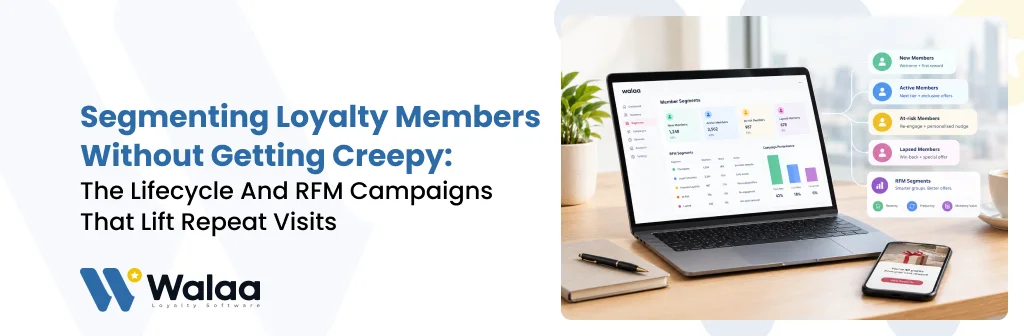
Most loyalty programmes send the same message to every member and then wonder why open rates fall month after month. The instinctive fix is "more personalisation," which usually turns into a sprawling set of micro-segments nobody has time to message, or into campaigns that feel uncomfortably knowing. The version that works is much simpler: three or four well-chosen segments, each with a clear action attached, and a firm rule that every message should be something the member would recognise as useful.
Start with lifecycle, not personality
Lifecycle segments are defined by where a member sits in their relationship with your brand. They're the highest-return place to begin because they map directly onto the moments where a nudge changes behaviour.
New members (first 30 days). The goal is a second visit. This is the single most important conversion in the programme, because a member who returns once is far more likely to keep returning. A welcome message that shows the first reward within reach does more than any generic discount.
Active members. Regular earners who need recognition and a visible next step, not discounts they would have used anyway. Show progress toward the next tier or reward, and reserve offers for moments that genuinely add value.
At-risk members. People whose gap between visits has stretched well beyond their own normal rhythm. The key is comparing each member to their own pattern rather than a fleet-wide average: someone who normally visits every ten days and has been silent for thirty is at risk, while a quarterly visitor at thirty days is perfectly normal.
Lapsed members. No activity for a defined period. These need a win-back offer with a real reason to return, and a limit on how long you keep trying before you stop messaging.
Add RFM where you have transaction data
RFM scores members on recency (how recently they bought), frequency (how often they buy) and monetary value (how much they spend). Even a simple three-band version produces useful groups: your best customers, your promising newcomers, and the high spenders who have gone quiet. That last group is usually where a targeted offer pays back fastest, because these members have already proven they value you.
You don't need a data science team. Three bands on each measure gives 27 combinations, which you can collapse into five or six named groups with a plain-language action for each.
What "not creepy" means in practice
Use what members gave you for the purpose they expect. Purchase history driving a relevant offer feels like good service. Referencing something a member never told you, or a pattern they didn't know you were tracking, feels like surveillance.
Make the value visible. "You're 40 points from your next reward" is personalised and helpful. A message that reveals how much you know about someone's habits is not.
Cap frequency. Even a perfectly targeted message becomes noise at three a week. Set a ceiling per member across all campaigns, not per campaign, so overlapping programmes don't stack.
Respect consent and channel preference. Data protection expectations are rising across GCC markets, and a member who has opted out of WhatsApp should not receive WhatsApp. Honour the channel they chose.
Measure with a holdout
Keep a small control group that doesn't receive the campaign. Without it, you can't tell incremental visits from visits that would have happened anyway, and an unmeasured campaign almost always looks better than it was. A 10% holdout is usually enough to read the result within a few weeks, and the discipline of testing is what separates a programme that learns from one that just sends.
Why choose Walaa
Walaa's segmentation and campaign tools build lifecycle and RFM groups directly from your live transaction data, with frequency caps, consent handling and holdout groups built into the workflow. Marketing can define a segment, launch a campaign and read incremental results without a ticket to a data team, and the rules engine models the cost of an offer before it goes live.
Walaa is a loyalty software platform built so segmentation drives measurable repeat visits instead of more noise.