

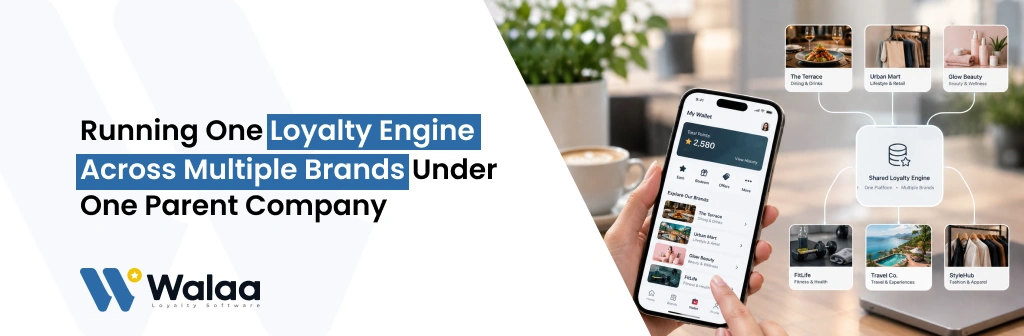
A restaurant group with six brands, or a retail holding company with a handful of separate chains, eventually asks the same question: should each brand run its own loyalty programme, or should there be one shared engine underneath all of them? The instinct to keep brands separate is usually right for marketing and positioning. It's usually wrong for the loyalty infrastructure underneath.
Why "separate programmes" quietly costs more
Running six independent loyalty programmes means six independent integrations, six rules engines to maintain, six redemption catalogues to keep current, and six sets of reporting that don't talk to each other. Beyond the obvious maintenance overhead, it means the group has no single view of a customer who eats at two of its restaurant brands — each brand sees a stranger where the group actually has a loyal, high-value customer spending across its whole portfolio.
A shared engine underneath separate brand-facing experiences solves this without forcing every brand to look and feel the same to the member. The member sees Brand A's app, Brand A's colours, Brand A's tone — the shared infrastructure is invisible to them. What changes is that the group now has one wallet, one identity record, and one data layer behind all of it.
What actually needs to be shared, and what shouldn't be
Shared: the member identity and wallet. A single customer record, recognised across every brand in the group, with a points or wallet balance that can be structured to work across brands — either as one unified balance or as a group-level currency that converts into brand-specific spend. This is the part that actually creates cross-brand value: a member who earns dining out at Brand A and redeems at Brand B is a retention story a siloed programme can never tell.
Shared: the rules engine and reporting layer. One place to configure earn rates, one place to run cross-brand promotions, one dashboard for group leadership to see performance across the whole portfolio — segmented by brand when needed, but not artificially separated at the infrastructure level.
Not shared: the brand-facing experience. Each brand's app, tier names, reward catalogue and promotional calendar should stay distinct. A luxury hospitality brand and a casual dining brand in the same group have very different member expectations, and forcing them into an identical experience because the backend is shared defeats the purpose of running separate brands in the first place.
Configurable: earn and redemption rates per brand. A shared engine doesn't mean identical economics. Brand A might earn at a different rate than Brand B, reflecting different margins and different average transaction values — the rules engine needs to support that per-brand configuration without needing a separate platform instance to do it.
The cross-brand promotion opportunity
The single biggest advantage a shared engine unlocks is the cross-brand promotion — "dine at Brand A this month, get bonus points redeemable at Brand B's retail stores." This is close to impossible to execute cleanly across genuinely separate platforms, because it requires real-time visibility into both sides of the transaction and a shared settlement logic between brands that, on separate systems, has to be built as a custom integration project every time. On a shared engine, it's a rules configuration.
Where groups get this wrong
The most common mistake is retrofitting a shared engine after each brand has already built its own programme independently — migrating years of member history, reconciling different point valuations, and managing the member communication around a change that can read as a downgrade if handled poorly. The cleaner path is deciding on shared infrastructure before the second brand's programme launches, even if the first brand already has one running; migrating one programme onto shared rails is a far smaller project than reconciling several.
Why choose Walaa
Walaa's platform is built around exactly this separation: one identity and wallet layer, one rules engine and reporting dashboard, with each brand's app, tiers and catalogue configured independently on top of it. A restaurant or retail group can launch brand two, three, or six on the same infrastructure that's already running brand one — without a fresh integration project each time, and with the cross-brand view group leadership actually needs.
Walaa is a custom loyalty platform built to run one engine across multiple brands, with each brand's experience staying distinct.