

They simply stop engaging. Yet an expiry policy is also one of the main tools for keeping a points liability under control, which is why finance teams tend to push for it and marketing teams tend to flinch. The good news is that fair and effective are not opposites. The programmes that handle expiry well treat it as a reminder mechanism, not a trap.
Why expiry exists at all
Unredeemed points sit on the balance sheet as a liability. Without any expiry, balances accumulate indefinitely, forecasting becomes harder, and a large pool of dormant points can suddenly be redeemed at once if a member base wakes up. Expiry limits that tail and encourages members to engage with the rewards you are paying for.
It also keeps the programme honest about activity. A member who has not transacted in two years is not a loyal member in any useful sense, and carrying their balance forever distorts reporting.
The main models, and how members experience them
Fixed expiry from earn date. Each batch of points expires a set period after it was earned, for example twelve months. It is simple to explain, but it is also the most punishing, because a member can lose points steadily even while remaining active.
Rolling expiry on activity. Points expire only after a period with no earning or redeeming activity. Any qualifying activity resets the clock. Members generally see this as fair, because staying engaged protects their balance, and it keeps liability aligned with genuinely dormant accounts.
Expiry at a fixed calendar date. All points lapse at the end of a year or season. It is easy to administer but creates sharp redemption spikes and a cliff members dread.
No expiry, with inactivity closure. The balance never expires, but the account closes after a long period of inactivity. This can work for premium or travel-style programmes where balances are large and trust matters.
Whichever model you choose, the rule should be stated plainly at enrolment and visible in the member's account, not buried in terms and conditions.
What makes expiry feel fair
Warn early and repeatedly. A single email the week before expiry is not enough. A sequence at ninety, thirty and seven days, across the channels the member actually uses, turns expiry into a prompt to return rather than an unpleasant surprise.
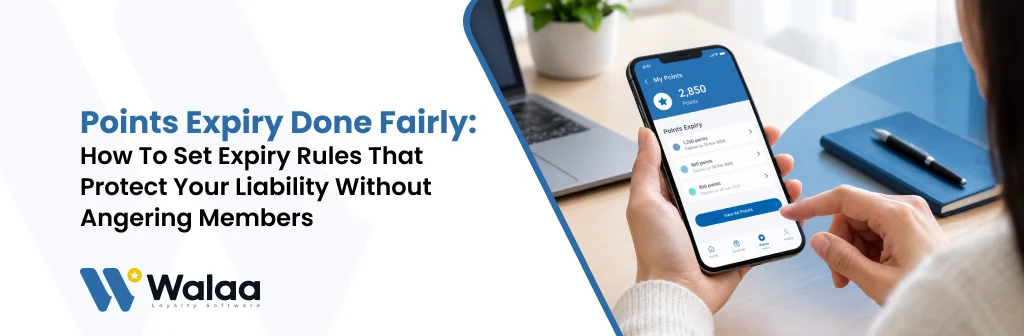
Show exactly what expires and when. A balance screen that lists points by expiry date removes the guesswork and lets members plan.
Make it easy to save the points. Offer an obvious action that extends them, such as a small purchase, a redemption or a login. If saving points requires effort and spend, members read the policy as extractive.
Allow goodwill exceptions. Support teams should be able to reinstate points in clear circumstances, such as a long hospital stay or a system error, with a reason code and an audit trail so exceptions do not become a loophole.
Keep reward thresholds reachable. An expiry window shorter than the time it realistically takes to reach the cheapest reward guarantees frustration. If members cannot get there, no communication will save the relationship.
Model before you commit
Expiry changes behaviour, so historical breakage is a poor guide once the rule changes. Model redemption curves under the new policy, test it on a segment first where possible, and agree a breakage assumption with finance that you will review against real results. Check legal and regulatory requirements for your markets before launch, as consumer protection expectations around expiry vary and are evolving.
Why choose Walaa
Walaa's points ledger supports fixed, rolling and activity-based expiry, tracks every point by earn date, and drives the warning sequence automatically across the member's preferred channels. Members see exactly what expires and when, support teams can reinstate points with a reason code and audit trail, and finance can see the liability impact of any rule change before it goes live.
Walaa is a loyalty software platform built so expiry rules protect your balance sheet without costing you your members.